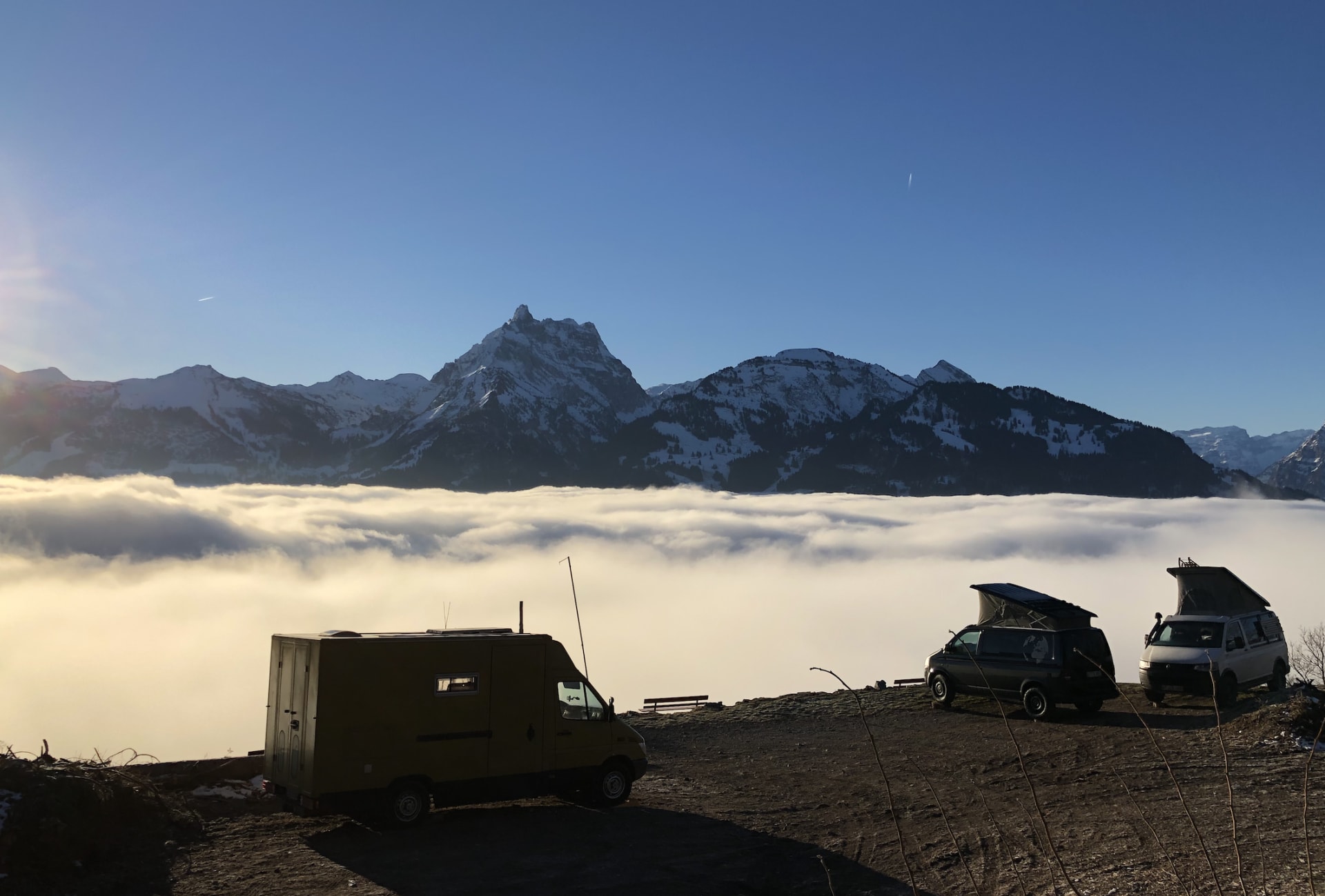
1.Overview
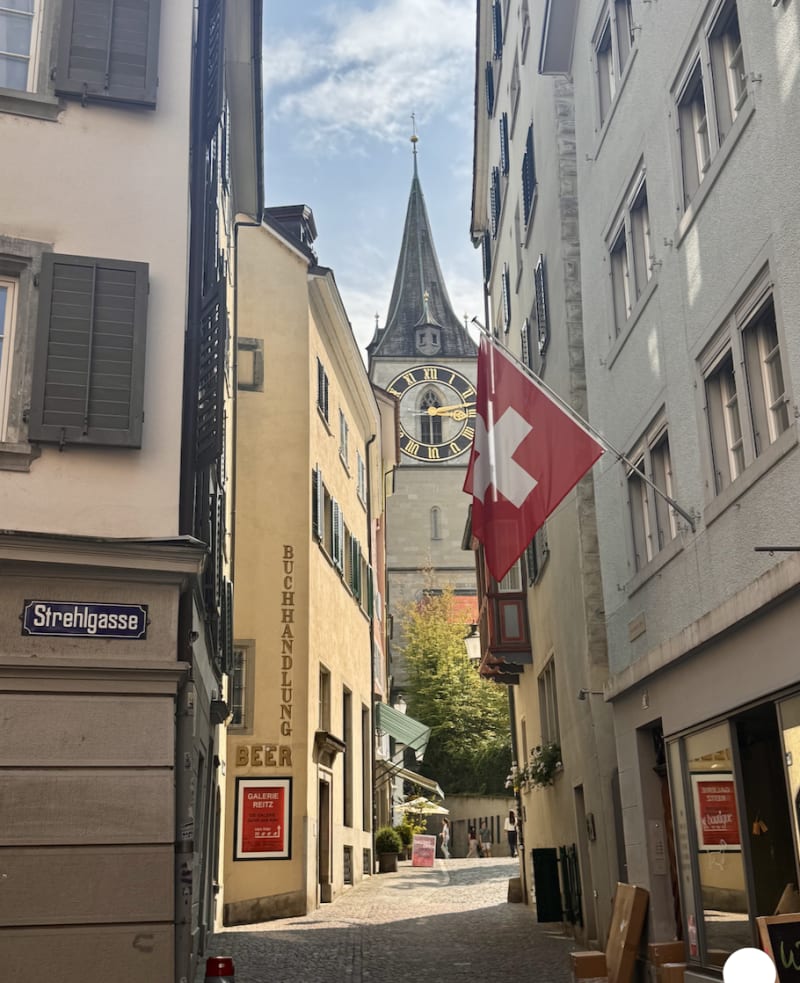
Switzerland - a country where turquoise lakes, jagged Alpine peaks, ancient villages, winding mountain passes and an almost impossibly clean environment create a landscape that feels like a postcard brought to life.
Everywhere you go, the scenery seems carefully arranged: wooden chalets covered in flowers, cows grazing on emerald meadows, waterfalls dropping from cliffs, trains climbing impossibly steep mountainsides.
It’s a place where you can wake up beside a lake, drive over a legendary mountain pass, park above the clouds for lunch, and end your day beside a glacier or vineyard.
This guide brings together every essential detail to help you plan the perfect Switzerland roadtrip.
2.Getting There
2.1 Arriving with Your Own Motorhome
Most travellers reach Switzerland by road through neighbouring countries. You’ll usually pass through with nothing more than a brief glance at your passport.
The main entry routes include:
Germany → Basel, Zurich, St. Gallen
The northern access points. Roads here are wide, calm and straightforward — the easiest approach for most travellers.France → Geneva, Lausanne or Basel
Ideal if you're coming from western Europe, with beautiful views of the Jura and Lake Geneva.Italy → Ticino (Lugano / Locarno) or via the Alps
Gorgeous but mountainous routes. Crossing the Alps via the Gotthard, Simplon or San Bernardino region gives you spectacular scenery immediately.Austria → St. Gallen or Graubünden
Perfect for entering the east of Switzerland or heading straight toward the Engadin, Davos or St. Moritz region.
Switzerland’s geography means that even relatively short distances can involve tunnels, steep climbs and rapid weather changes. It’s all part of the adventure — just make sure your motorhome is ready for mountains.
2.2 Toll System (Motorway Vignette + Extra Fees)
Switzerland uses a simple but strict system: you must buy a motorway vignette if you drive on any national motorway (“A” road).
The vignette:
costs 40 CHF
is valid for a full calendar year
is mandatory for all vehicles under 3.5 t
You can buy it:
at the border
at petrol stations in neighbouring countries
online (digital vignette)
This makes travelling easy — once you have it, you don’t stop at toll booths.
Special Fees
However, some routes are not included in the vignette, such as:
private mountain roads
car trains (Autoverlad) like Lötschberg, Furka, Vereina
certain tunnels (e.g., Munt la Schera Tunnel to Livigno)
Prices vary from around 15 CHF to 35 CHF depending on the route.
These transfers are extremely popular because they save hours of mountain driving and are very motorhome-friendly.
3.Entry & Formalities
3.1 Documents
Switzerland is part of the Schengen area but not a member of the EU, so it has its own rules.
Motorhome travellers must carry:
passport or EU ID
vehicle registration
proof of insurance
pet passport + microchip + rabies vaccination if travelling with animals
Because Switzerland is outside the EU customs union, certain items like alcohol, tobacco, meat and dairy products are controlled.
3.2 Money & Payments
Switzerland uses the Swiss Franc (CHF).
The good news:
Credit and debit cards are accepted almost everywhere.
Many places accept euros but the exchange rate is poor.
4.Driving
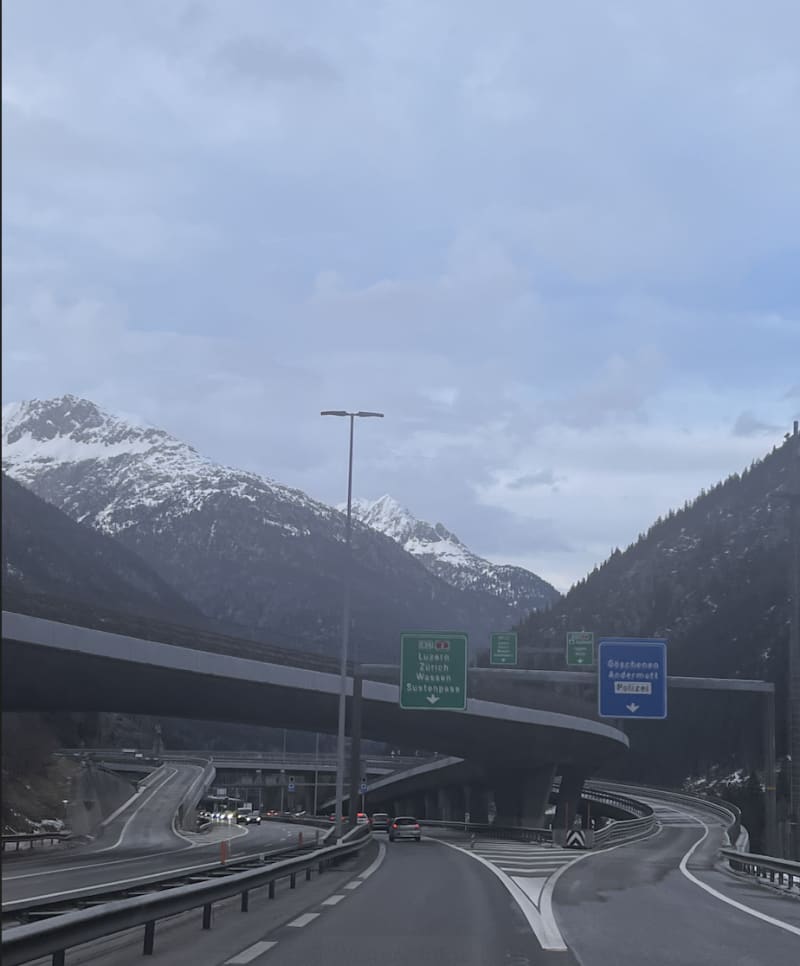
4.1 Speed Limits
Speed cameras are automatic and everywhere - and fines are among the highest in Europe. Drive gently and enjoy the scenery. Switzerland is strict with speed limits and fines:
50 km/h in towns
80 km/h on rural roads
100 km/h on national roads
120 km/h on motorways
4.2 Mountain Roads
Driving the Alps is magical, adventurous and sometimes intimidating. If you’ve never driven mountain passes before, take your time and avoid weekends when traffic is heavier.
Expect:
narrow roads carved into cliffs
dramatic hairpins
sudden fog or storms
long steep descents
breathtaking viewpoints every 2 minutes
4.3 Weather
Weather changes fast in Switzerland. A sunny valley can turn into a snowstorm at 2.000 m altitude in minutes. Always:
check road conditions
avoid passes in thunderstorms
prepare for strong winds
keep your fuel tank half full
4.4 Driving Mountain Passes With a Motorhome
Some of Switzerland’s biggest highlights are its high mountain passes — legendary, dramatic, and unforgettable.
Famous passes suitable for confident motorhome drivers:
Furka Pass
Grimsel Pass
Gotthard (including the historic cobblestone Tremola)
Susten
Klausen
San Bernardino
Oberalp
Bernina
Driving them requires:
strong brakes
good weather
avoiding peak weekends
5.Camping
Switzerland offers some of the most beautiful and best-organised camping options in Europe. Whether you love lakes, forests, mountaintops or vineyards — there is a place for you.
5.1 Official Campsites (~650 nationwide)
Large Swiss campsites feel almost like mountain resorts. They are clean, professional and surrounded by sensational scenery.
You will find:
immaculate bathrooms
private wash cabins
laundry rooms
fresh bread service
Wi-Fi
playgrounds
restaurants or cafés
rental bikes, SUP boards or kayaks
direct access to lakes, forests or hiking trails
Coastal-style resorts line the lakes of Thun, Lucerne and Geneva, while mountain campsites in Graubünden, Valais and Bern offer unforgettable alpine views.
Prices:
25–45 CHF (low season)
45–70 CHF (high season)
70–110 CHF (premium lakeside & spa campsites)
Despite the price, the level of comfort is extremely high.
5.2 Stellplätze (Motorhome Stopovers)
Switzerland has hundreds of motorhome stopovers - simple, quiet areas designated for motorhomes, usually run by towns, or farms.
They typically include:
legal overnight parking
waste disposal
fresh water
electricity (sometimes)
views of lakes, rivers or mountains
walking distance to towns or cable cars
Prices range from free to 15–30 CHF. They feel nearly like wild camping — peaceful, practical, and fully relaxed.
5.3 Wild Camping — Canton by Canton Rules
Switzerland’s wild camping laws are unique and complicated. They depend entirely on the canton (regional government) and even the municipality.
General guidelines:
Wild camping with a motorhome is often prohibited at low altitude, especially near lakes, forests and towns.
National parks, nature reserves and protected landscapes have strict bans.
Fines can be high in heavily visited regions.
In practice:
Most travellers use RV parkings instead of wild camping.
They provide the same peaceful “close to nature” feeling but without risking trouble.
6.Services
Water & Waste Disposal
Switzerland is one of the easiest countries in Europe for finding fresh water and dumping waste — even in remote regions.
You’ll find V+E (fresh water, greywater and toilet disposal) at:
almost every campsite
hundreds of Stellplätze / motorhome stopovers
many marinas along lakes and rivers
several fuel stations
some public parking areas, especially in mountain regions
Swiss service stations are famously clean and well-maintained. Operating them is straightforward, signage is clear, and the water quality is excellent — Switzerland’s tap water is some of the purest in the world.
Gas
Switzerland uses its own gas bottle system, which means:
Foreign bottles cannot usually be exchanged
Refilling is sometimes possible, but not guaranteed
The most reliable options:
Carry a European adapter kit
For long trips, buy a Swiss gas bottle on arrival (campsites and hardware stores sell them)
If you're travelling through the Alps early or late in the season, gas is essential — nights can be cold even in June or September.
Shopping & Groceries
Switzerland has an excellent network of supermarkets, with long opening hours and a wide range of high-quality products.
Major chains:
Coop – wide selection, good fresh foods
Migros – excellent produce, slightly cheaper
Denner – budget-friendly
Lidl / Aldi – best for saving money
Volg – small village shops, surprisingly well stocked
Weekly markets are a highlight. Fresh alpine cheese, homemade bread, smoked meats, mountain honey, local wine and seasonal fruit make cooking in your motorhome a pleasure.
Internet & Connectivity
Switzerland has outstanding 4G/5G coverage, with signal even in many mountain regions.
Options:
EU travellers: many roaming plans now include Switzerland (check your provider)
Local SIM cards: Salt, Sunrise, Swisscom offer reliable prepaid options
Campsites: almost all provide Wi-Fi, often fast and stable
Remote mountain regions: short dead zones can happen behind cliffs or in deep valleys
7.Routes
The Grand Tour of Switzerland
This is Switzerland’s official round-trip route — a curated 1,600 km loop through the country’s most iconic sights.
It connects:
22 lakes
12 UNESCO heritage sites
5 alpine passes
charming old towns
famous panoramic viewpoints
The route is signposted and ideal for motorhomes, offering a perfect balance between nature, culture, cities and quiet countryside.
Many travellers spend 10 to 21 days following it.
8.Highlights
• Matterhorn – iconic mountain (4,478m)
• Jungfrau – mountain massif, glacier
• Lake Geneva – largest lake in Switzerland
• Lake Lucerne – picturesque lake
• Lake Constance – lake, lowlands
• Aletsch Glacier – largest glacier in the Alps
• Rhaetian Railway – spectacular railway line, UNESCO World Heritage
• Zurich – largest city, culture, financial center
• Bern – capital, old town, UNESCO World Heritage
• Geneva – international city, lake
• Basel – culture, Rhine banks
• Lucerne – lake, culture, Chapel Bridge
• Interlaken – tourism center, mountains
• Zermatt – mountain village, Matterhorn
• Hiking in the Alps
• Skiing in winter
• Water sports on the lakes
• Cycling
• Climbing
• Culture and city tours
• Glacier hikes
• Fondue – melted cheese
• Raclette – melted cheese
• Rösti – potato dish
• Älplermagronen – pasta dish
• Beer – Swiss beer
• Chocolate – Swiss chocolate
• Cheese – over 450 varieties
9.Costs
Switzerland is expensive, but quality is high.
Estimated costs:
Campsites: 25–110 CHF
Stellplätze: 0–30 CHF
Diesel: above EU average
Groceries: moderate to high
Eating out: expensive
Coffee: 4–6 CHF
Motorway vignette: 40 CHF
Money-saving tips
Travel in May, June or September
Use motorhome stopovers
Stay outside major tourist hotspots
Drink tap water (excellent quality)
Buy fuel before entering Switzerland
10.Safety
Switzerland is a very safe travel destination, but there are some points to note.
Sudden weather changes can be dangerous in mountains
High winds & storms are common at altitude
Always chock your wheels on steep parking spots
Hike only on marked trails
Always have enough fuel
Mountain passes can be closed in winter
Emergency number: 112